It turned out to be a cold summer day on the campus of Texas A&M University–Kingsville on June 26, when ICE (U.S. Immigration and Customs Enforcement) agents descended without warning. They detained more than two dozen contracted construction workers employed by Cotton Disaster Solutions.
These workers had been hired to restore infrastructure damaged in a recent fire at MSUB.
News of ICE raids and ambushes has spread across the United States throughout the month of June. Cities such as Los Angeles, New York City and San Antonio have witnessed large-scale protests, as Americans denounce what many are calling a weaponized federal agency under the Trump administration.
There have been numerous reports of plainclothes ICE agents going door-to-door, inquiring about Latino families’ legal status and detaining individuals without clear cause or due process—in an apparent effort to deport any migrant encountered, regardless of legal status.
Six months into the Trump administration, the intensification of immigration enforcement is no longer surprising. What is surprising—and to many, shocking—is how this inhumanity has now reached institutions of higher learning.
The ICE raid at Texas A&M University–Kingsville may have been inevitable, but the university’s response did not reflect the urgency or concern appropriate to the aggressive and militaristic manner in which these workers were apprehended. That, in itself, is the most alarming aspect.
A construction worker who spoke to The South Texan described the event as resembling a military ambush. “They were already here-they were hiding when we arrived, they were hiding behind some dumpsters and hallways,” Freddie, a contractor, said.
Texas A&M University–Kingsville has long taken pride in its Hispanic student body. As we celebrate the university’s centennial, a glance at the archives reveals just how far we have come in the realms of diversity and inclusion.
However, those same archives also remind us of darker chapters in our history—when the Confederate flag was once proudly displayed on campus, and when traditions like Miss TAMUK (then Miss Texas A&I) were segregated, resulting in the creation of separate titles such as Miss Black Texas A&I.
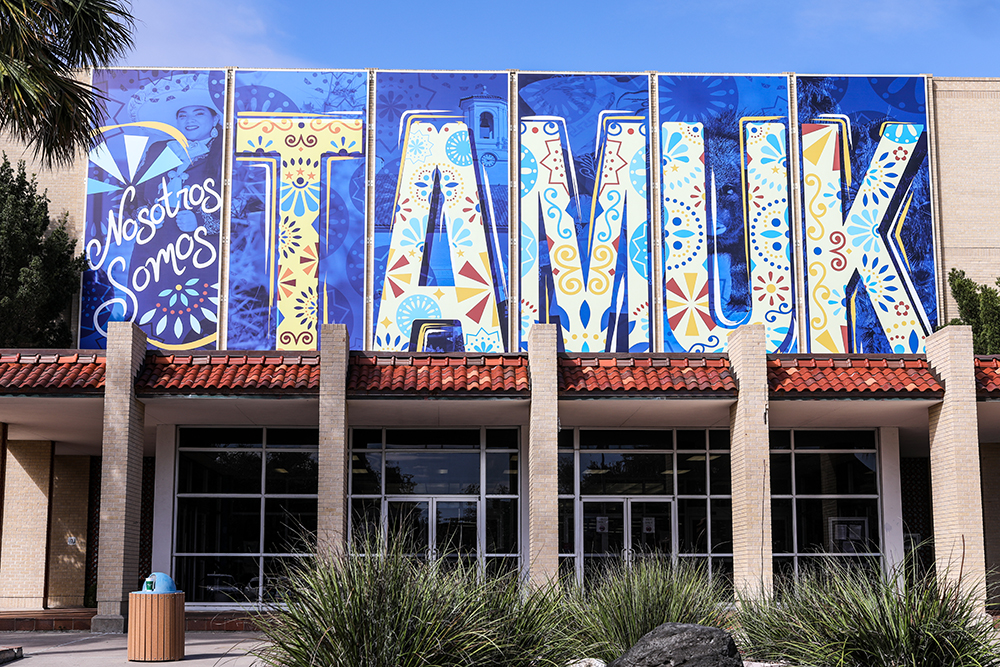
Perhaps the most visible emblem of cultural pride on our campus is the mural above the Jernigan Library bearing the words Nosotros Somos TAMUK (“We Are TAMUK”).
The Hispanic and Latino community, which makes up most of the student body and faculty, is often spotlighted as a defining feature of the university. This mural, intended as a celebration of cultural identity and inclusion, is often used by Marketing and Communications to promote Latino student recruitment.
“Me being Hispanic, it makes me really nervous, you know, because it’s a Hispanic-based school,” said a student of TAMUK to KIII TV after the Thursday raid.
However, following the recent ICE raid, and the university’s delayed response to The South Texan’s reporting, a different story began to emerge.
A press release was not issued until the end of the day—despite repeated requests for comment.
This delay raises an uncomfortable question: If TAMUK truly is the campus of culture it so proudly and strategically markets, why did it appear to quietly open its doors to federal agents targeting members of the very community it claims to serve?
The mural above the library once served as a beacon of inclusion.
But following these events, many Latino students and faculty members can’t help but question whether that same mural, in this centennial year, has become a trap—drawing in Latino students with the promise of opportunity, only to leave them vulnerable to ambush.
The mural boldly states, We Are TAMUK. But what does that really mean? Are we a campus that embraces the rich diversity of our student body?
Or, are we a campus that turns in those who walk its halls on the mere premise of suspicion?
Like thousands of students and faculty members who come to campus each day to learn, to work, and to build better futures, the two dozen contractors who were apprehended were doing the same — coming to work to improve their lives.
Instead, they were met with an ambush.
One hundred years later, racial divides still persist. And the question of where the university stands remains painfully unclear.
The traditional Mexican saying “dime con quien te juntas y te Diré quien eres” is certainly being asked to TAMUK.
NOSOTROS SOMOS TAMUK. So, what are we, TAMUK? Or perhaps the better question is: What have we become?