‘Interstellar Corporation’ debuts Mars rover
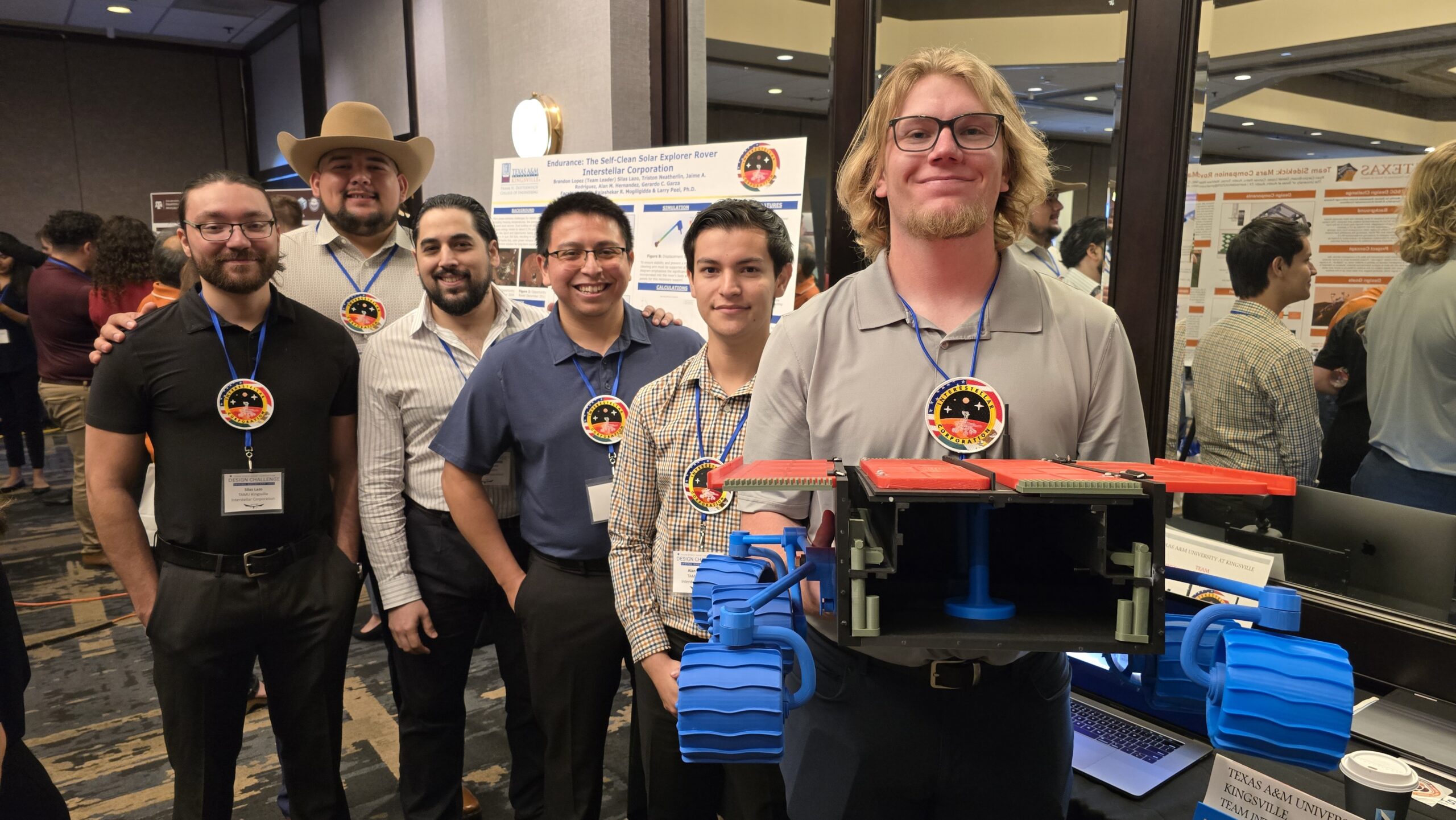
Six Texas A&M University-Kingsville (TAMUK) College of Engineering students competed in the NASA–Texas Space Grant Consortium (TSGC) Design Challenge Showcase.
This competition spanned over a semester in which they worked and designed a Mars rover and ended in a showcase in which they competed against 25 other universities.
They were then judged by a panel composed of NASA engineers and experts, as well as TSGC-affiliated professionals and faculty members.
TAMUK’s team was named the “Interstellar Corporation” in which they designed “Endurance,” a solar powered self-cleaning version of the Mars rover.
Endurance placed first for Best Model & Display, fifth place for Best Poster, sixth place in Top Peer Review and eighth place overall among the Top Design Teams.
“Our primary focus was on the model and display area in which we proudly took first place. As a design challenge, we grounded our work in technical research, studying numerous NASA reports on the Spirit and Opportunity twin rovers. While it was difficult to find highly detailed documents of the rovers due to their status as government property, learning from the twins’ components and mission journey gave us the foundation to develop our own concept: Endurance, a self-cleaning solar explorer rover,” Brandon Lopez, a student who competed in the NASA-TSGC competition, said.
Lopez didn’t design Endurance on his own though it took a combination of Alan Mauricio Hernandez, Silas Quin Lazo, Gerardo Garza Jaime, Alberto Rodriguez and Triston Neatherlin to bring their ideas together.
“A well-balanced team that plays to its strengths is essential – understand[ing] the full scope of your project, then assembl[ing] your team accordingly. Do your homework, identify every potential challenge in your approach and develop solutions that tackle multiple issues at once. Study your competitors, learn from their strengths, and raise your own game,” Hernadez said.
The rover had to be lightweight, robust enough for handling dust and integrate mechanical cleaning systems.
This is when the Interstellar Corporation got to work.
Using a 3D printer filament, the team was able to build Endurance in four months and craft a first-place rover.
“The team spent several months designing a Mars rover using SolidWorks and then fabricating it using FDM 3D printers. They had to consider NASA’s mission constraints, perform simulations, and refine both the mechanical and aesthetic aspects of their design. Beyond the technical work, the students also developed a professional display and presentation, which contributed to their success at the competition,” TAMUK Professor Rajashekar Mogiligidda said.
Mogiligidda was also extremely proud of his students’ work and was also adamant on how important these events can be to lead the future of science and engineering.
“It’s an honor and a highlight of my role as an educator. Seeing our students succeed at a NASA-sponsored event reinforces the value of hands-on learning and the strength of our engineering program at Texas A&M University–Kingsville. It’s moments like these that remind me why I’m passionate about teaching and mentorship,” Mogiligidda said.
Interstellar Corporation will continue to compete in the NASA-TSGC competition which has another showcase in the fall. The team has already started work, with goals set on an even better Endurance.