World-renowned primatologist, anthropologist and humanitarian Jane Goodall, died Oct. 1 at the age of 91 in California.
Known globally for her groundbreaking work with chimpanzees, Goodall transformed the world’s understanding of primate behavior.
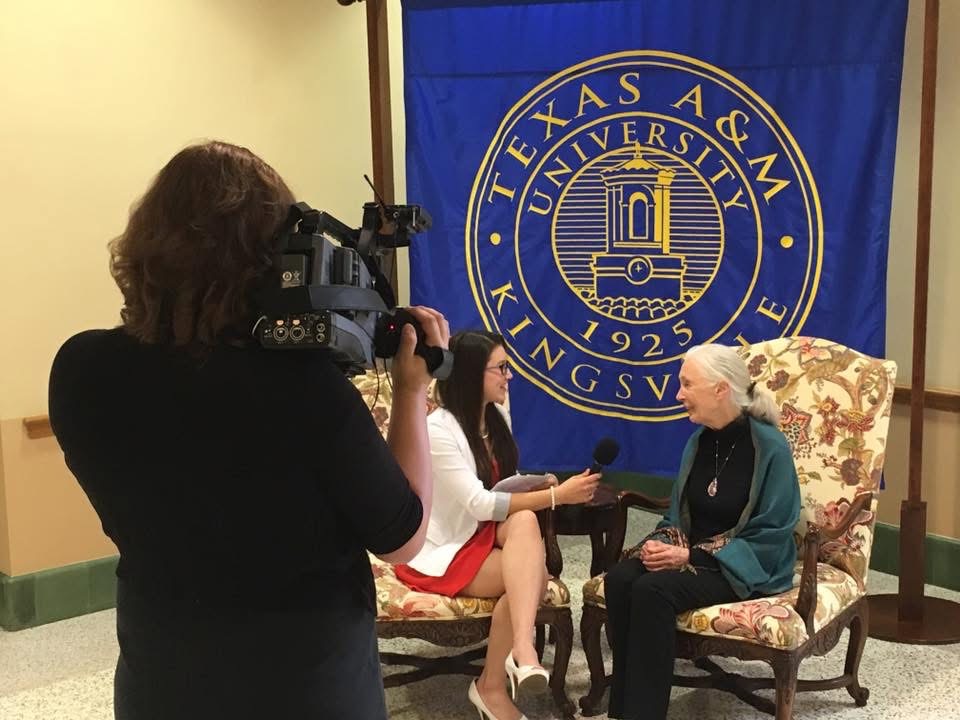
In 2016, Texas A&M University–Kingsville welcomed Goodall as part of its lecture series. During her visit, Goodall spoke about her remarkable career and met with the university’s Anthropology Club, which hosted the anthropologist and humanitarian during her visit.
Dr. Christine Reiser-Robbins, Associate Professor of Anthropology and Coordinator of Anthropology, reflected on her legacy.
“Dr. Jane Goodall was brought to campus through the University Lectureship Series in March 2016. The Lectureship Series is a student-supported program, with a speaker decided upon by a committee. At the time, the process was overseen by Ms. Erin McClure, now assistant dean of students. Student organizations were invited to assist in hosting Dr. Goodall’s experience on the day of her visit,” Reiser-Robbins said.
Goodall spent most of her life studying the behavioral aspects of chimpanzees, beginning her research in her early 20s. She went on to lead what remains among one of the longest and most extensive studies, surpassing many of her male contemporaries.
Her doctoral thesis, Behavior of the Free-Ranging Chimpanzee (University of Cambridge, 1965), remains a highly referenced work among anthropologists and primatologists.
“Members of the Anthropology Club had the opportunity to attend a meet-and-greet reception with Dr. Goodall. I was so incredibly proud to see our TAMUK students ask her poignant and thoughtful questions about her work in global conservation and the connections they made to our own region,” Reiser-Robbins said. “For all her travels and tireless advocacy, I could see in Dr. Goodall’s interactions with our students that she found it truly inspiring to connect with young generations passionate about their communities, their environment and the world. It meant a lot to witness that genuine passion, care and connection. The Anthropology students also asked light-hearted questions, like did she have favorite chimpanzees. I thought she’d be neutral and say no, but she said, yes!”
Goodall’s influence extended beyond the forests of Tanzania, becoming an outspoken advocate for humanitarian causes and environmental conservation. In recent years, a petition with over 150,000 signatures circulated online, calling for her nomination for the Nobel Peace Prize — an honor she never received.
“Being a member of the host club to receive her and spend some extra time with her, Anthropology Club gave me the privilege to hold a conversation with someone so inspiring and legendary. I felt so starstruck being able to ask her a question one on one. It’s one of my biggest brags I tell new people I meet, the fact that I met Jane Goodall at TAMUK of all places,” Victoria Moyorido-Muñoz (B.S. 2015, M.S. 2019) said.
“It meant so much to my inner child. Growing up with loving animals you had your favorites. My two favorites were Jane Goodall and Steve Irwin. Both of them showed me how beautiful animals can be. They also taught me compassion towards animals and nature. Being able to meet Jane made the little animal lover and tree hugger inside me so happy. It was like a dream come true, I’m so lucky,” Moyorido-Muñoz said.
Goodall’s visit to TAMUK garnered much fanfare and attention from local media. The lecture opened to a packed theater for a moment bringing the bright spotlight of the science elite to small town Texas. It would reinforce the academic level and prestige of the science community of South Texas.
“Dr. Goodall’s lecture touched on her life story of how she came to be a primatologist, how she was selected for a pioneering research role, some of the insights she has gleaned of primate behavior in her more than six decades of research, the significance of conservation efforts, and the multi-generational, multinational global institute she has created to advance these efforts.” Reiser-Robbins said.
Goodall leaves behind a storied legacy not just on primates but a study and everlasting impression on the human condition.
“It is overwhelming in all the best possible ways to meet one of your idols. Dr. Goodall’s pioneering work as a female scientist – researching in a field setting, no less – has inspired,” Reiser-Robbins said.