Enrollment stays level
In its Centennial Year 2025 Texas A&M-University-Kingsville (TAMUK) has seen its fair share of ups and downs, but one area has recently held steady, enrollment.
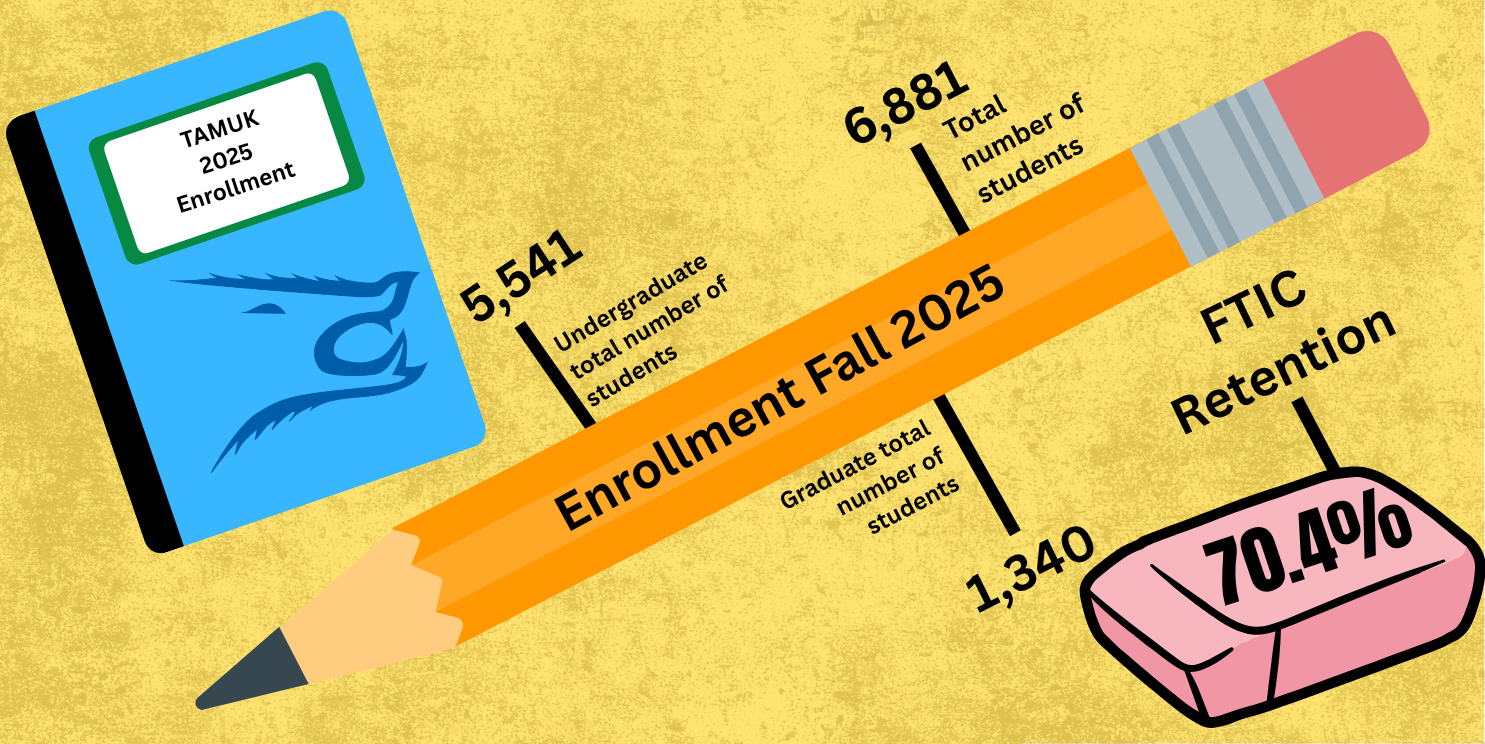
TAMUK’s fall preliminary data shows 6,881 students enrolled.
This year TAMUK has seen a slight drop in just 222 students from last year’s total fall enrollment of 7,102 students.
However, the decline in students can be put on the fact that the America has seen a 42% decline in international students, according to the university.
TAMUK President Dr. Robert Vela recently said First Time in College (FTIC) retention sits at 70.4%, the highest retention rate in six years.
Transfer enrollment increased by nearly 11% and overall semester credit hours, which increased by more than 2%.
“This tremendous achievement is thanks to the effort of so many of you and the relentless Student Success team. Last year, we set a 4DX (4 Disciplines of Execution) target retention rate of 70%. Our collective efforts have allowed us to achieve that goal,” Vela said. “I’d like to congratulate the Frank H. Dotterweich College of Engineering for its focus on retention, which resulted in a more than 76% FTIC retention rate for the college, the highest rate among the colleges.”
Much of the improvement is thanks to 4DX, officials said, which focuses on three key areas – new student enrollment, continuing student retention and timely progress to graduation.
This strategy has begun to show its effectiveness with the university’s retention rate on the rise.
“These frameworks help ensure accountability and keep us focused on key performance metrics that track our progress. Daily registration reports are accessible to all faculty and staff, offering real-time insights into who has and hasn’t registered. This enables more targeted and effective outreach efforts,” Vice President for Enrollment Management Dr. Rosalind V. Alderman said.
The university has placed much focus on area recruitment.
“One key focus is ‘doubling down in our own backyard’ — ensuring local students have every opportunity to pursue a post-secondary credential,” Alderman said. “We continue to strengthen our dual credit efforts by increasing both the number of high school partners and student participation. Our partnerships with community colleges are also yielding strong results, particularly in transfer student enrollment. In addition, we are expanding our academic offerings by launching high-demand undergraduate and graduate programs — such as nursing — to attract students who may not have previously considered us as a viable option.”