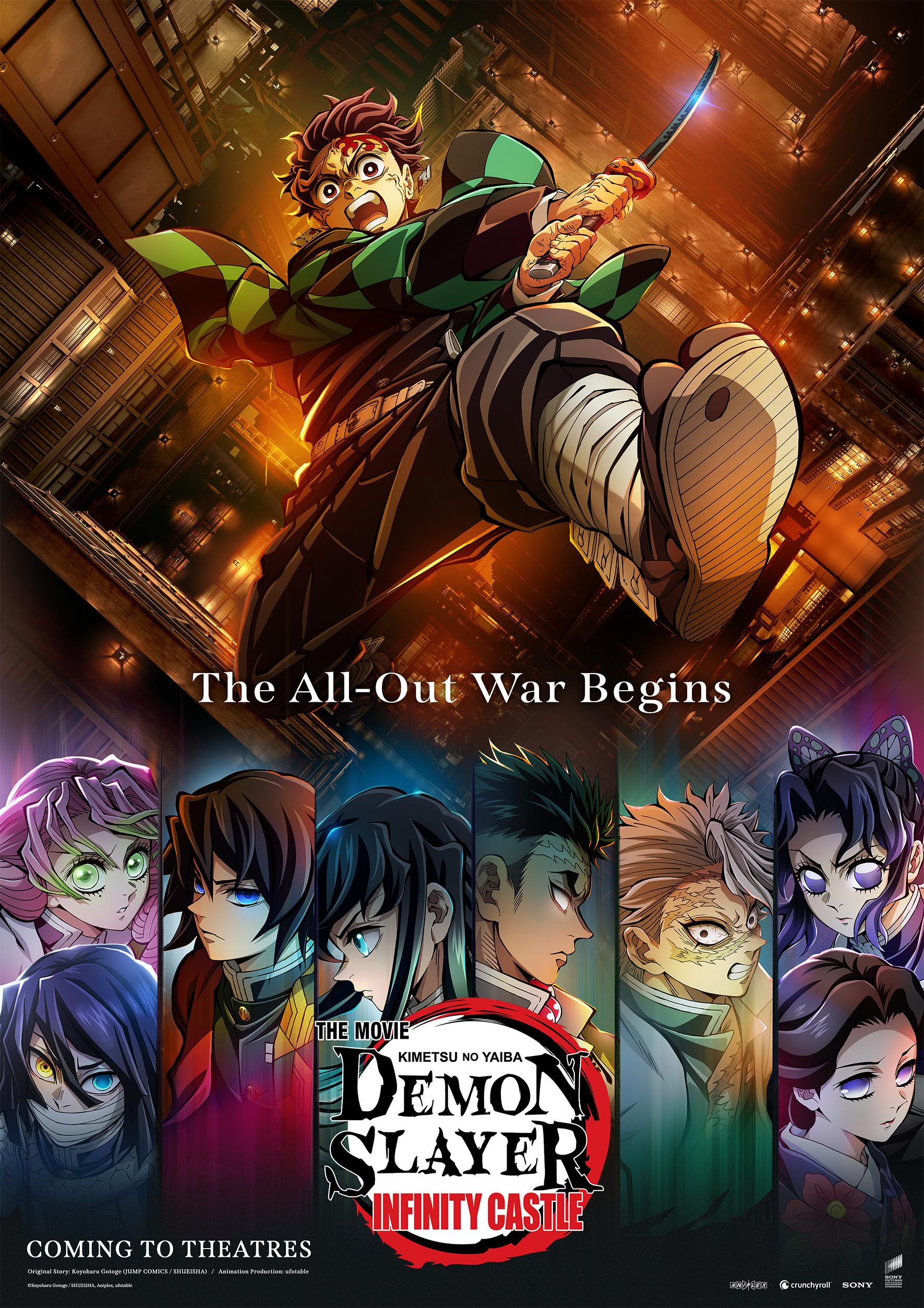
Strengths in animation, cinematography
“Demon Slayer: Infinity Castle”(2025), directed by Haruo Sotozaki and produced by Ufotable, begins the climactic final arc of the Demon Slayer saga. Picking up immediately after the events of Season 4, the film strands Tanjiro, the Hashira and the Demon Slayer Corps within Muzan’s shifting stronghold, forcing desperate confrontations with demons from the Upper Moon ranks. The film’s ambition is twofold to deliver spectacle worthy of the big screen and to deepen the emotional stakes of its characters. In this review, I will examine three critical axes the film’s visual and technical achievements, its narrative structure and pacing, and its characterization and emotional impact assessing how each contributes to or detracts from the movie as a whole.
The most immediate and least controversial strength of Infinity Castle lies in its animation, cinematography and design. Ufotable continues its signature blending of 2D hand animation with 3D-rendered environments, resulting in fight sequences that feel both fluid and cinematically composed. Critics note that the castle’s labyrinthine corridors, with their non-Euclidean twists, evoke comparisons to Doctor Strange’s mirror dimension or Interstellar’s spatial distortions. The visual staging enhances tension and spectacle lighting, color contrast and dynamic camera angles often carry emotional weight even in silent moments.
Yet technical excellence alone is not sufficient. The film largely delivers on its promise of spectacle, using sound design and score to heighten key scenes rather than overwhelm them. The battles feel visceral. However, occasionally the visual richness competes with narrative clarity; in rapid sequences, viewers unfamiliar with character designs or motifs might find spatial orientation challenging.
Where Infinity Castle draws criticism is in its structural rhythm. As with many manga adaptations, the film intersperses extended flashback sequences especially in the case of Akaza with ongoing battles. While these backstories are meant to imbue even villainous characters with tragic depth, their placement often disrupts momentum. Several critics and viewers argue that too many interruptions “battle, flashback, return to battle” cause a cyclical pacing that undermines dramatic peaks. In particular, Akaza’s long flashback arc is often cited as dragging mid‑fight, making it feel more like a multi‑episode TV arc squeezed into film form than a tightly paced cinematic story.
The decision to divide the final arc into a trilogy also means that many narrative threads end on unresolved notes. The film sometimes feels episodic, as if several TV episodes were stitched together. As a stand-alone movie experience, it lacks closure in many respects even though within the broader franchise arc it may function well.
The adaptation attempts to deepen empathy for both sides of conflict. Rather than portraying the demons as one‑dimensional monsters, the film dedicates screen time to their formative traumas, regrets and motivations. This moral complexity is one of its more ambitious goals. Tanjiro, the Hashira and supporting characters also confront vulnerability, fear and loss. The emotional stakes, sacrifice, redemption, grief are often earned, especially when the film allows moments of quiet reflection between the spectacles.
However, the challenge lies in balance. Because the cast is large, some characters receive minimal focus. Emotional beats for minor or side characters can feel rushed or underdeveloped. In scenes where the film attempts to juggle multiple arcs simultaneously, some emotional moments compete rather than harmonize. The emotional density can also contribute to viewer fatigue; by stacking one tragic reveal atop another, the film sometimes overextends its ability to land each moment with full impact.
Overall, Demon Slayer Infinity Castle is a bold, emotionally ambitious and visually sumptuous installment. Its greatest achievement is the way it weds spectacle with thematic depth inviting us not just to watch epic battles, but to feel the weight of loss, choice and identity across both heroes and villains. Nonetheless, structural compromises, especially pacing unevenness and its fragmentary nature undermine its effectiveness as a singular cinematic experience.
In evaluating Infinity Castle, one must consider its dual role part of a larger saga and a standalone film. As the first act of a trilogy, it succeeds in raising stakes and deepening character motivations as a standalone movie, it occasionally feels overlong, interrupted, or incomplete. On balance, I assess Infinity Castle as a strong, if imperfect, entry a film that more often illuminates than frustrates, but that asks for patience from its audience. If I were to score it purely on cinematic terms, I’d place it at around 8 out of 10 a film whose strengths are compelling, though whose structural flaws hold it back from perfection.