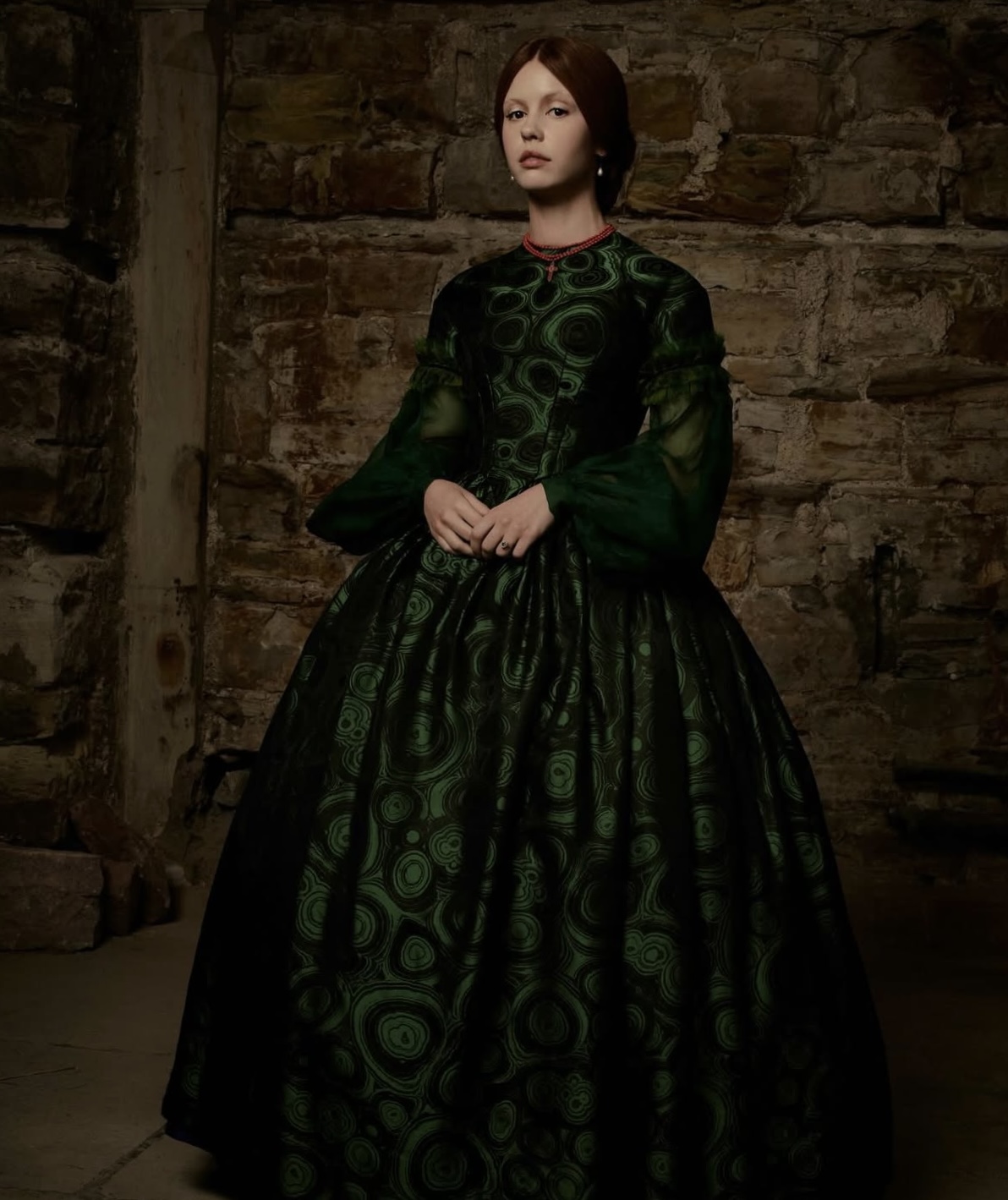
Captivating, Victorian pieces buzz audiences
Not only was “Frankenstein” perhaps one of the most anticipated films to drop—a monster-sized ambition, not to mention a brave adaptation of Mary Shelley’s classic 1818 novel—it’s an achievement by the master of the macabre, Guillermo del Toro. But the fashion that also dropped was something we weren’t ready for. Acclaimed costume designer Kate Hawley was tapped again by del Toro to scientifically and meticulously craft the gothic Victorian aesthetic for the film.
Arguably one of the most striking scenes in the film comes at a telling moment of a young Victor Frankenstein. His mother—also played by actress Mia Goth—is seen bidding farewell to his father on the steps of Frankenstein Manor. A blood-red bustle gown with a simple yet overly dramatic silk veil draped over the young mother’s face was a cinematic achievement only fashion could achieve. The blood-red color would be threaded throughout the entire film; for Victor Frankenstein in his adulthood, red would be seen in some form.
With the introduction of Elizabeth, the love interest of both Frankenstein and his monster—played by Goth also—deep greens, violets and floral-filled bonnets perfectly frame the face in a ghostly crown of a saint who finds herself between two worlds.
“The veils! That’s a bigger moment. And in other moments, you need to pull it back so the focus can be on something smaller, otherwise it’d take you out of the story. The color palette is key to that. For instance, Harlander [Victor’s wealthy patron played by Christoph Waltz] has his color palette. But then you have Elizabeth, and she keeps shifting. It’s like a metamorphosis,” Kate Hawley told British Vogue.
Elizabeth’s fascination with the monster continues to be told through the fashion—a deeply thought-provoking character whose presence at times on screen was only the rich, lustrous costume she was placed in. A subtle yet overpowering statement of wardrobe instead of words.
The jewels were yet another detail of del Toro’s “Frankenstein” that can’t be overlooked. Tiffany & Company provided rare archival pieces to be adorned by Goth in the film, archival pieces that were not your usual Tiffany-Esque designs. One choker of meticulously carved emerald beetles worn by Goth, provided just enough macabre with a pinch of glamour for the scene. It quietly presents itself.
“We partnered with Tiffany on the jewelry and I went to their archives. In their collection from over the last 200 years, there are echoes to Mary Shelley’s world and the Age of Enlightenment, and then you have the Victorian period – in the 1850s, Tiffany was creating surgical instruments for the Civil War, and it was an age of modernism. So, you have the old-world styles of Charles Lewis Tiffany, and then his son, Louis Comfort Tiffany, who comes in and rewrites the rulebook with much less traditional and more artistic, glass styles. The blue beetle necklace Elizabeth wears is a unique Louis Comfort Tiffany piece from the early 1900s,” Hawley said.
The men of the film are also not without their moment. Frankenstein’s monster, played by Jacob Elordi, after a brush with wolves, particularly creates a tattered fur coat, accentuating his monstrous shoulders but providing a warm, heartbreaking thought: the wolves used to create the fur killed the only companion in the film he had ever known.
In literature and film lore, Frankenstein’s search for a companion is a catalyst to the plot of the novel and now this new adaptation—for what would Frankenstein’s monster be without his bride, a homage at the centerpiece of the film. Mia Goth presents herself in a wedding dress at the film’s peak, the dress completely made of silk-satin bandages in virginal white, in a tribute
to the Bride of Frankenstein.
The film, now streaming on Netflix, is perhaps at the head of the Oscar race thus far. Although a departure from the original narrative of the novel, its overarching themes stay the same, and its dramatic dressing will no doubt earn a nomination for Best Costume. This film is a reminder that costume design is at times one of the most important pieces, highlighting cinematic narrative.